
Workflow Automation Audit: Finding the Right Process to Automate First
A practical workflow audit for identifying repetitive, high-volume processes with clear handoffs, predictable rules, manageable exceptions, and useful operational value.
 Sun Cluster Inc.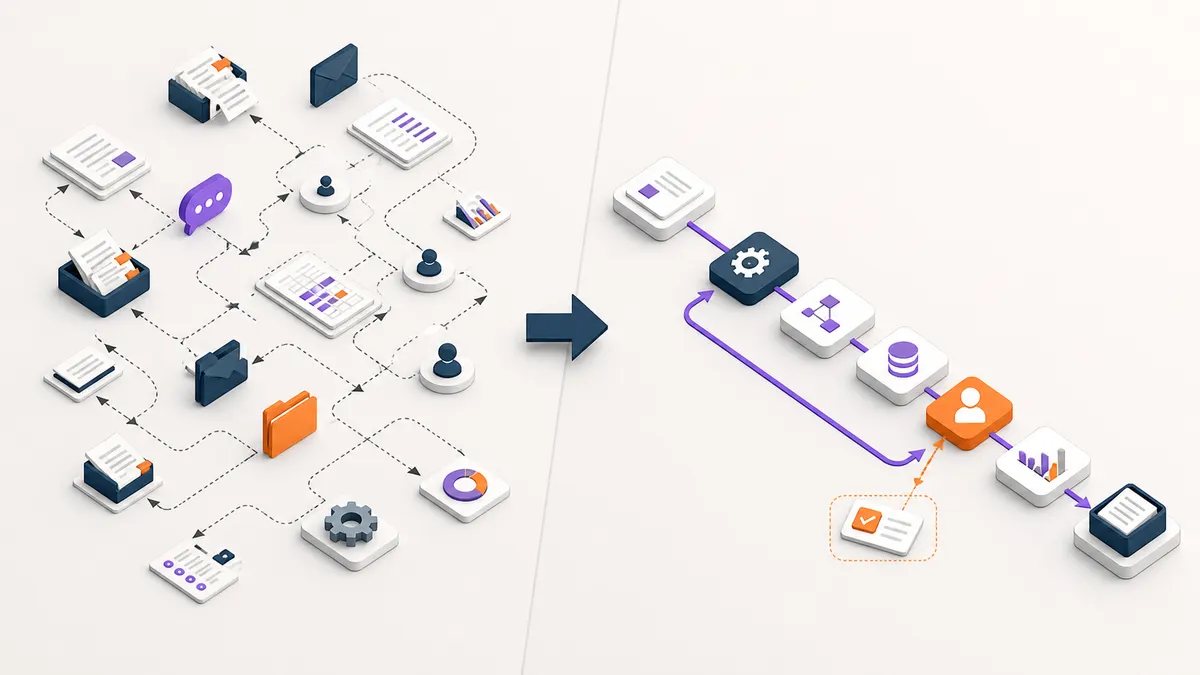
Before automating a workflow, understand how work actually moves today. An audit separates repetitive work that software can support from exceptions that still need human judgement.
Map the current workflow
Follow one real request from start to finish. Record people, systems, inputs, decisions, waiting periods, handoffs, and the information that gets copied or re-entered.
Find repetitive high-volume work
Look for recurring tasks such as routing a request, sending a reminder, checking completeness, updating a status, or compiling a report. Frequency and consistency often matter more than apparent complexity.
Measure handoffs and waiting
Delays often occur between teams rather than inside a single task. Identify who waits for what, which queues have no owner, and where a notification or status view would reduce follow-up.
Separate predictable rules from exceptions
Automation works best for explicit decisions. Keep uncertain cases, sensitive approvals, and judgement calls visible with a human escalation route instead of hiding them inside a brittle rule set.
Estimate operational value honestly
Consider time saved, reduced rework, clearer status, lower error exposure, and better customer response—not invented ROI figures. Pick a first workflow where the value can be observed after release.
Choose a bounded first improvement
Define one process, a clear owner, success criteria, and the systems involved. A small reliable automation gives better evidence for later work than a broad transformation programme.
Score candidates before choosing the first automation
Compare potential workflows against a few practical criteria: frequency, manual effort, clarity of rules, exception rate, data readiness, number of systems involved, and a named owner. The highest-volume process is not automatically the best first candidate if it is full of undefined exceptions.
Choose a bounded process where the team can observe whether the new workflow reduced rework, follow-up, or delays. That evidence supports later automation decisions without inventing a return on investment in advance.
- Frequency and repeated effort
- Clarity of rules and exceptions
- Source-data reliability
- Named process and operational owner
Common questions
What kind of workflow should not be automated first?
Avoid processes with no stable owner, unclear rules, unreliable data, or highly sensitive judgement calls until those foundations are addressed.
Can an audit recommend no automation?
Yes. Sometimes clearer ownership, better configuration, or a small process change should happen before engineering an automated workflow.
Discuss your software project
Have a defined workflow, integration, or delivery question? Tell us about the technical constraints and the outcome your team needs to support.
Contact Sun Cluster